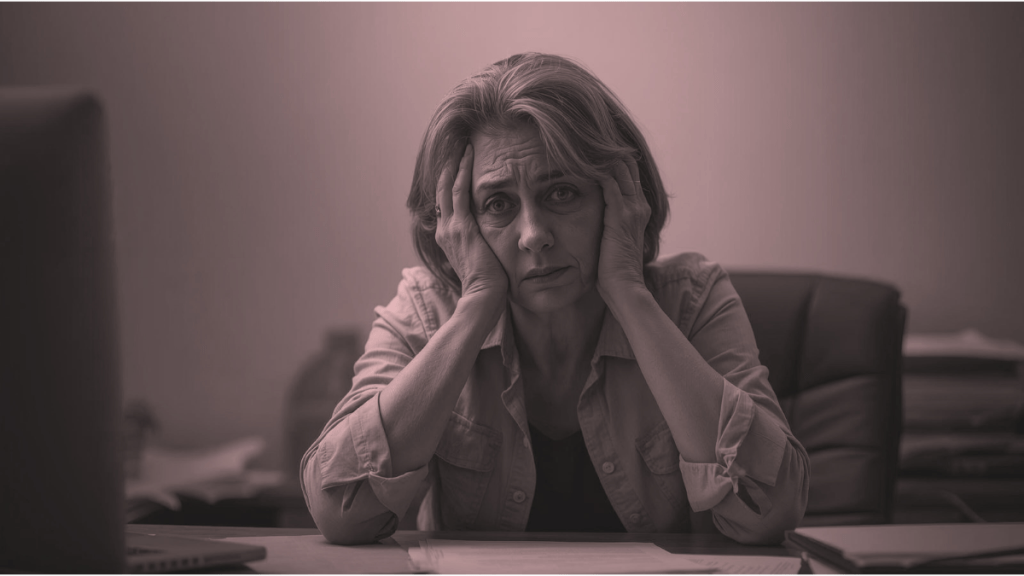
For most of my life, I believed I was simply bad at being an adult.
Not spectacularly bad. Just… quietly, consistently struggling in ways I couldn’t quite explain. I worked hard. I cared deeply. I looked successful from the outside. But inside, it always felt like I was running an operating system that everyone else had mastered while I was still clicking “help” and hoping for the best.
Then I hit my early 50s.
The menopause arrived.
And everything that had once been just about manageable fell apart.
This is the story I didn’t know I needed to hear, and maybe you do too?
When Coping Strategies Stop Coping
Menopause didn’t create my difficulties. It exposed them.
The brain fog. The emotional volatility. The exhaustion that sleep didn’t fix. Suddenly, all the systems I’d built over decades, the lists, reminders, over-preparation, people-pleasing, sheer force of will…. stopped working!
Things I’d always found hard became impossible.
I forgot words mid-sentence. Lost track of tasks I’d just started. Read the same email five times and still didn’t know what it said. Decisions, even small ones, felt overwhelming. My brain would stall, like a car refusing to start while everyone else waited (and watched).And the most unsettling part?
I started to wonder if I was losing my mind.
“Exhausted and Afraid”
This is the bit we don’t talk about enough.
Being over 50, peri- or post-menopausal, and suddenly not functioning in the way you always have, it’s terrifying.
I was exhausted, tired to the core and afraid.
Afraid of losing my job.
Afraid of being “found out”.
Afraid that I was too close to retirement age to start again, yet too young to stop.
Sleep is more than elusive, it’s become an unreachable obsession. When I do sleep, it isn’t restorative. The brain fog has thickened. Organising has become harder. Decision-making has slowed to a crawl.
At work, it feels like:
- Eyes on me
- Clock ticking
- Don’t mess this up
So I over-check. And over-check again. And again.
Fear of mistakes turn into paralysis.
Fear of exposure makes everything take twice as long.
What people see is someone “being careful.”
What I feel is someone barely holding it together.
Anxiety and ADHD are not polite housemates and menopause invites them both to throw a party at 3am (or whatever ‘witching-hour’ suits).
The Moment of Realisation
The idea of ADHD didn’t arrive with a bang.
It crept in quietly. A podcast here. An article there. A sentence that landed a little too close to home.
Women. Late diagnosis. Masking. Exhaustion. Menopause making it worse.
I remember thinking, “Well, that’s uncomfortably familiar.”
Then came the reflection. The memories. The mental rewind of my life, now playing with a different soundtrack.
And suddenly… things made sense.
The Pointers I Missed (Or Ignored)
Looking back, the signs were everywhere. I just didn’t know how to read them.
- Always feeling like I was working harder than everyone else for the same results
- Procrastination mixed with panic-fuelled last-minute brilliance
- Emotional sensitivity disguised as “caring too much”
- Chronic overwhelm hidden behind competence
- Being praised for being calm and capable while internally screaming
I didn’t miss deadlines — I feared them into submission.
I wasn’t organised — I was compensating constantly.
I wasn’t lazy — I was exhausted from managing my own brain.
But in the 80s, 90s, and early 2000s, ADHD looked like naughty boys who couldn’t sit still. I worked in the Special Educational Needs sector for a while and this was what I saw, not high-achieving women quietly drowning under invisible pressure.
So I learned to mask. And I became very, very good at it (until now).
What Success Really Looked Like
From the outside, my career looked solid. Even impressive.
From the inside, it was powered by:
- Over-preparation
- Hyperfocus marathons
- Imposter syndrome
- Burnout cycles
- And a constant low-level fear of dropping the ball
Every promotion came with a private panic.
Every new role meant reinventing my coping strategies from scratch.
People saw confidence where I felt chaos.
ADHD didn’t stop me from succeeding but it made success costly and physically and mentally exhausting.
Career progression wasn’t a smooth climb; it was a series of sprints, crashes, recoveries, and quiet self-blame. I often wondered why I found things harder than others and assumed the fault lay with me.
Menopause removed the buffer. The adrenaline. The hormonal support. Suddenly, the effort required became visible, even to me.
The Relief of Naming It
Getting to the point of recognising ADHD in my 50s was emotional.
There was grief, for the years spent thinking I was broken.
Anger, that no one noticed.
Relief, profound, validating relief.
Because here’s the truth:
If this resonates with you, your experience is real.
You are not imagining it.
You are not failing.
And you are not alone.Menopause doesn’t make you incompetent.
It reveals what you’ve been compensating for all along.
A New Kind of Compassion
Understanding ADHD hasn’t magically fixed everything. I still lose my phone while holding it. I still open the fridge and forget why. I still go upstairs on a mission to find something and when I arrive I wonder why I’m there. I still have days where my brain refuses to cooperate.
But now, there’s context and kindness.
And the ability to stop asking, “What’s wrong with me?”
Instead, I ask, “What do I need?”
Sometimes the answer is rest.
Sometimes support and understanding.
Sometimes laughter at the sheer irony of discovering this at 56.
Better late than never.
If You’re Wondering…
If you’re a woman over 50, navigating menopause and quietly thinking, “This feels harder than it should” then trust that instinct.
You’re not imagining it.
You’re remembering yourself more clearly than ever.
And that realisation, however late it comes, can be the beginning of a gentler, truer chapter.
If you’ve gone from ‘doing fine’ to ‘why is everything so hard?’, this is for you 🤍
Read another blog: The Quiet Aftershock No One Warns You About
If this resonates, you’re welcome to share your thoughts in the comments below. Your experience might help someone else feel less alone 🤍
 The Invisible Struggle
This is a moderated, respectful space. If this article resonates with you, you’re welcome to share your reflections below. Your experience may help someone else feel less alone. You’re welcome to comment using a nickname. Your email address is never published or shared — it’s only required to help prevent spam and keep this space safe.