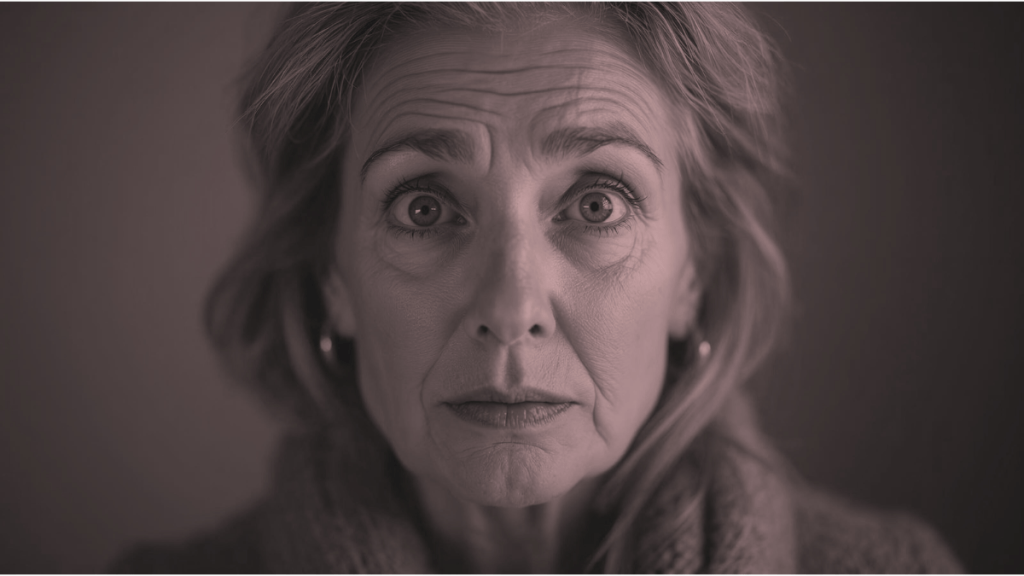
No one tells you what happens after the penny drops.
After the late-night Googling.
After the “oh… that explains a lot.”
After you stop questioning whether it’s “just the menopause” and start recognising a pattern that’s been there your whole life.
Because the realisation that you might have ADHD in your 50s doesn’t arrive neatly packaged. It ripples. It echoes. It quietly rearranges how you see yourself — and your past. And menopause, as ever, makes sure you feel all of it.
The Emotional Hangover of Understanding Yourself
There is relief, of course. Deep, bone-level relief.
But there’s also something else that sneaks in when you’re not expecting it. A heaviness. A tenderness. A sense of looking back at your younger self and feeling… complicated.
You remember moments you brushed off at the time.
The exhaustion you normalised.
The intensity you downplayed.
The overwhelm you hid behind humour, competence, or silence.
And now, with new language and context, you see them differently.Not as personal failings.
Not as weakness.
But as signals that went unheard.
The Grief of the “What If”
This is the part we don’t rush through.
The grief doesn’t shout — it whispers.
What if I’d known sooner?
What if I hadn’t been so hard on myself?
What if I’d asked for help instead of assuming I was the problem?
It’s not about rewriting the past or wishing your life away. It’s about acknowledging that things were harder than they needed to be — and that no one told you why.
That grief deserves space. Not judgement. Not dismissal. Just kindness.And here’s something important:
Grieving what might have been doesn’t mean you’re ungrateful for what is.
It means you’re finally telling yourself the truth.
The Strange Loneliness of a Late Realisation
One of the oddest parts of all this is how invisible it can feel.
From the outside, nothing has changed. You’re still you. Still capable. Still getting on with things.
But inside, there’s been a quiet seismic shift.
You’re holding a new understanding of yourself that most people around you don’t see. And because ADHD in women — especially older women — is still misunderstood, it can feel isolating to carry it alone.
Which is why hearing other women say:
- “I thought it was just me.”
- “I thought I was losing my mind.”
- “I’ve never felt so seen.”
…can feel like oxygen.
You’re Not Drowning Alone
The comments, messages, and shared stories matter more than we realise.
They’re proof that this isn’t a personal crisis — it’s a generational blind spot finally coming into focus.
Women in their 50s and beyond are realising they didn’t suddenly become “less capable.” They became hormonally unsupported while carrying decades of invisible labour, emotional regulation, and self-management that no one ever acknowledged.
Finding others who get it doesn’t fix everything — but it softens the edges.
It turns isolation into recognition.
Shame into shared understanding.
Silence into connection.
And sometimes, it even lets you laugh at the irony of discovering this just as your tolerance for nonsense has completely disappeared.
What Comes Next Is Not a Decline — It’s a Reframe
This stage isn’t about diagnosing yourself into a corner or replaying your life on a loop.
It’s about meeting yourself where you are now — with more honesty, less blame, and far better questions.
Not:
“What’s wrong with me?”
But:
“What has always been true about me?”
“What do I need now?”
“What can I stop forcing?”
Menopause may have stripped away your buffers, but it’s also stripped away illusions — including the one that says you have to keep proving yourself.
If This Resonates…
If you’re a woman over 50, sitting with this quiet recognition and wondering why it feels both relieving and heavy, please know this:
Your experience is valid.
Your grief makes sense.
Your clarity is hard-earned.
You didn’t miss something obvious.
You lived in a world that didn’t know how to see you.
And now that you do — you don’t have to carry it alone.
This isn’t the end of the story.
It’s the point where the story finally starts being told truthfully.
And that, even now, matters more than you think 🤍
Read another blog: The Menopause Multiplier, When Masking Finally Fails
If this resonates, you’re welcome to share your thoughts in the comments below. Your experience might help someone else feel less alone 🤍
 The Invisible Struggle
This is a moderated, respectful space. If this article resonates with you, you’re welcome to share your reflections below. Your experience may help someone else feel less alone. You’re welcome to comment using a nickname. Your email address is never published or shared — it’s only required to help prevent spam and keep this space safe.